

|
|
|
| Home | | | Surfboards | | | Design | | | Surfing & Media | | | Surfcast | | | About NC | | | Custom Orders | | | Contact |
| |
|
| SURFBOARD HISTORY | |
| |
December 15, 2025 |
|
OVERVIEW
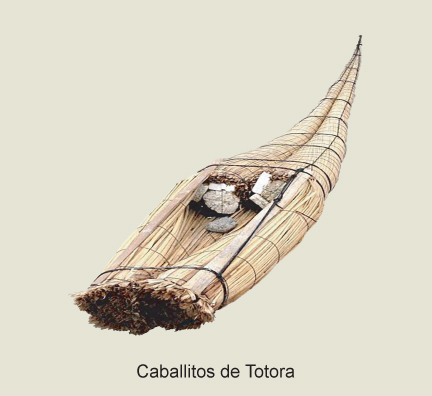
The evolution of objects creates, nurtures, and sustains innovation, improvement, and efficiency.Objects such as surfboards evolve to better meet the needs and expectations of surfers. The evolution and progression of wave craft and surfboards is no exception - from the Caballitos de Totora 3000BC in ancient South America to the hardwood Olos, Alaias, and Paipos 300AD in Polynesia and the Hawaiian Islands to the technical sandwich construction boards of 20th and 21st century. Identifying expectations and requirements of a surfboard's performance combined with imagination, creative and analytical thinking, introducing new technologies, and ultimately implementing solutions have been at the core of the evolution of surfboards. |
|
3000BC
CABALLITOS de TOTORA |
|
 |
|
|
The earliest documented wave riding craft and wave riding is from
archeological sites in Peru that date to 3000BC. Ancient South
American cultures made long, high bowed crafts by binding together a
local totora reed, the California Bullrush, that fishermen could
paddle out to sea through the surf and then ride waves back to shore
on their return. These craft were used for fishing and recreation.
Ranging from 9 to 15 feet in length, 3 feet wide, and weighed up to
90 pounds. The dried reeds were bundled together and bound to make a
shaped raft that would not be swamped by waves and white water. Local
fishermen were documented riding the craft either by lying face down
and paddling with their arms and hands or kneeling or standing using
a stick of bamboo as a paddle. When the Spanish arrived 4500 years
later, they documented the art and skill of the indigenous Chimu and
Moche people riding waves with these craft. These historical and
orginal wave craft were called the Caballitos de Totora or Little Red
Horses.
Although the ancient South Americans were the first to ride waves with their Caballitos de Totora, it was the ancient Polynesians and Hawaiians who were the first to create surfboards specifically to ride waves. The practice of he'e nalu - surfing - has deep roots in Polynesian and Hawaiin culture. |
|
300AD
POLYNESIAN / HAWAIIAN SOLID WOOD BOARDS |
|
 |
|
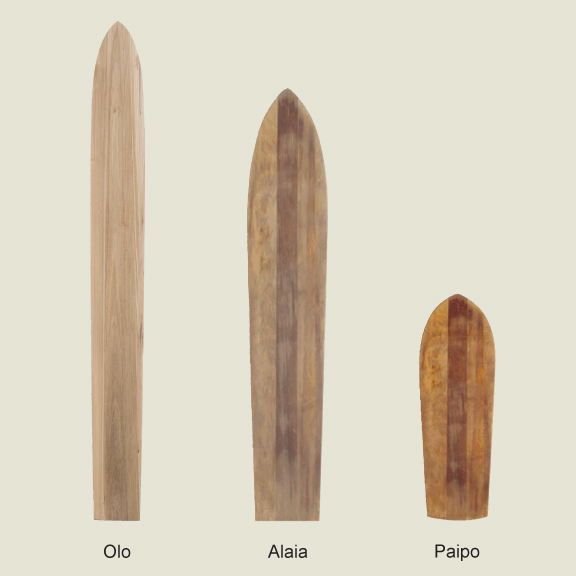
| Around 300AD, Polynesians migrated across the Pacific Ocean and settled in the Hawaiian Islands. They brought the culture of he'e nalu or surfing with them. The Hawaiians practiced surfing on three types of boards, the Olo, the Alaia, and the Paipo. These magnificent and timeless boards were crafted by hand after a ritual ceremony blessing the tree and the wood from Ula, Koa, and Willi Willi trees. These flat, solid planks of wood were part of the code of kapu that structured early Hawaiian society and were used in rituals, recreational activities, training for Hawaiian chiefs, and as a means of conflict resolution. The Olos were the longest of the boards used by the Hawaiians and were surfed exclusively by Hawaiian royalty, chiefs, and kings. Ancient Hawaiian Olos were 16 feet long 18 inches wide and 6 inches thick. The Alaias were the most versatile and widely used surfboard. They were 7 to 12 feet long and 18 inches wide with a round nose and a square tail. The Paipos were the smallest of the Hawaiian's surfboards. They were a flat board with a round nose ridden prone by commoners and children. Paipos varied in length from 3 to 6 feet with an average width of 16 inches and were 1/2 inch thick. When Captain Cook arrived in Hawaii in 1778, he was the first westerner to witness surfing. |
|
1910s to 1930s
SURFING'S REVIVAL - PLANKS, the CIGAR BOX & the HOT CURL |
| DUKE'S PLANK | |
 |
|
In the 1800s Western settlers in the Hawaiian Islands discouraged
surfing as contrary to their Puritan ethic. Recreation and nudity
being the primary issues. Surfing's revival occurred in the early
20th century when the US annexed Hawaii. North American settlers
arrived in the islands and their interest in local culture inspired
some of them to try surfing. This started a resurgence in the
popularity of surfing. Surfboards in this era experimented with the
different types of wood, especially redwood, that was being shipped
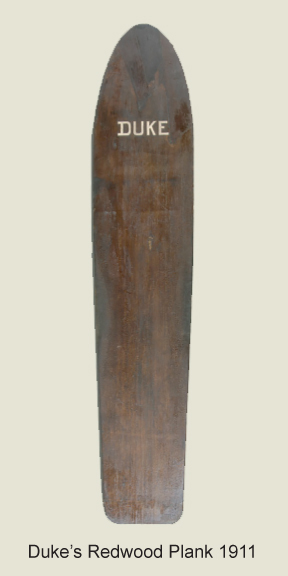
to Hawaii from the mainland US for use in construction. In 1910, Duke
Kahanamoku made his version of a Plank made of redwood, with a blunt
nose and square tail. Duke's board was 10 feet long, 23 inches wide,
3 inches thick. and weighed 70 pounds. His design was the prototype
for the Waikiki model made of pine wood.
HOLLOW LIGHTER BOARDS |
 |
|
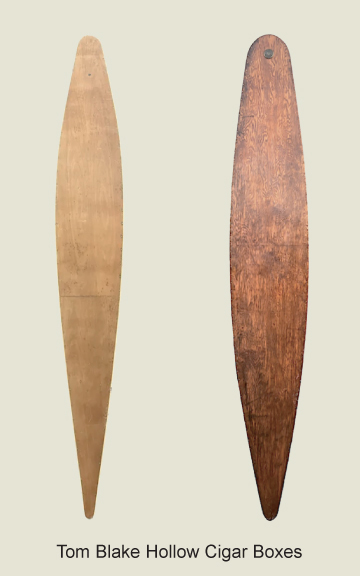
In 1929 Tom Blake revolutionized surfing when he created the
first hollow surfboard, later nicknamed the Cigar Box, by drilling
holes in a solid wood 15 foot long board to reduce weight. He covered
the top and bottom with a thin skin of plywood to seal the board.
Blake's hollow Cigar Box was notably lighter and easier to surf. He
further developed his idea into a skin on frame design and patented
it in 1931. It became the first mass produced surfboard design.
ORIGIN of RAILS and Fins |
 |
|
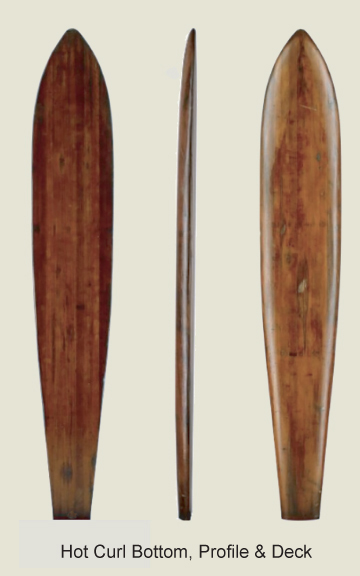
In 1934, inspired specifically by the fact that their boards
weren't holding an edge or engaging the face of waves and slid off
the face of waves too often and too easily, John Kelly and Fran Heath
took a notable step in surfboard design evolution when they shaved
off parts of the rail and tail of one of their plank surfboards
attempting to get more control and make their surfboards more
responsive and predictable. This adaptation was called the Hot Curl
because it allowed the surfers to maneuver in the curl of a wave.
In 1935 Tom Blake placed a small skeg on the bottom of board at the tail. It was 1 foot long by 4 inch deep skeg adapted from a small speedboat. After surfing with a fin or skeg as he referred to it for the first time Blake said, "When I first paddled out the board felt like it was much easier to keep in a straight line. I thought I might be imagining it. My first wave revealed the truth. Never before had I experienced such control and stability. It was remarkable the control you had over the board with this little skeg. I knew from that moment it was a success." Blake is widely credited with inventing the surfboard fin. The introduction of a fin on a surfboard changed surfing and surfboard design forever. |
| 1940s & 1950s | |
|
TRANSITION to NEW MATERIALS & EVOLVING SHAPES
Wood surfboards, often solid and always heavy, were being replaced by boards featuring new technologies that emerged during WWII. Balsa wood, EPS foam, resin, and fiberglass were materials incorporated into surfboard construction. In the '40s Simmons introduced a new concept in surfboard technology featuring a foam core, wrapped in plywood and balsa wood, then sealed with fiberglass and resin. Simmons embraced and applied the science of physics and emerging technologies to surfboard design. With his knowledge of hydrodynamics, Newton's Laws of Motion, and Bernoulli's Law of Lift, Simmons' shapes incorporated nuanced and subtle rocker, a curve from nose to tail, which helped boards fit into the curves of waves, trim, and turn with greater precision, control, and predictability. Additionally, he also incorporated equally nuanced bottom contours from rail to rail, a geometry of surface curves that created lift, stabilized laminar flow, and generated speed. These two design elements - rocker and bottom contours - are so fundamental they could be considered the foundation and basis of modern surfboard design. SANDWICH CONSTRUCTION SURFBOARDS |
 |
|
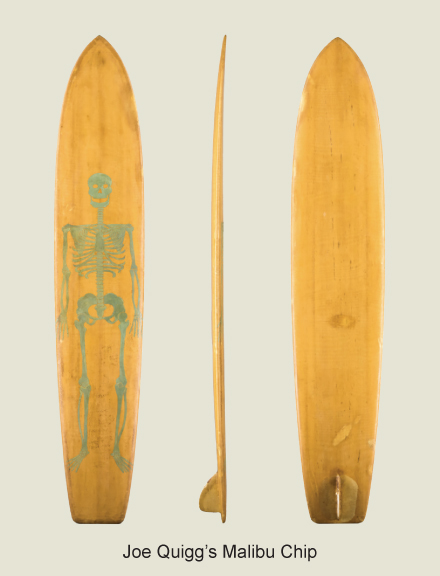
In 1947 Joe Quigg designed, shaped, and built the Malibu Chip
incorporating lightweight sandwich construction and featuring nuanced
rocker, bottom contours, rails, and fins. The board had a balsa wood
core and a fiberglass and resin skin. Quigg's Malibu Chip was
arguably the first lightweight high performance surfboard.
EARLY to MID 1950s |
 |
|
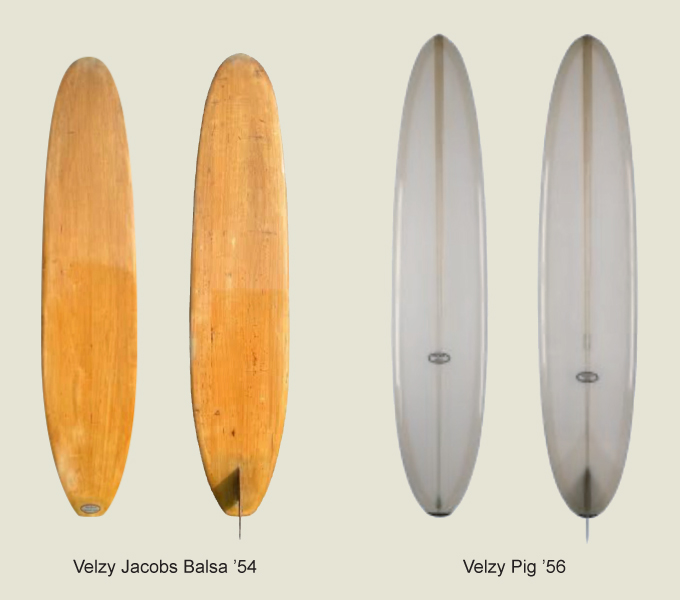
Simmons' and Quigg's genius, their ideas and creativity, and
their identification and exploration of fundamental surfboard design
elements is a constant in the thread of surfboard design. Simmons and
Quigg inspired Dale Velzy, Phil Edwards, Mike Diffenderfer, Mike
Hynson, Skip Frye, and Donald Takayama, shapers that used these
design elements to accelerate surfboard performance from the wood
era, to the foam and fiberglass era, the longboard revolution, and
ultimately to the shortboard revolution, and the very modern and
diverse classes of today's surfboards.
Of note is the transition to surfing more critical waves like Windansea, Rincon, and Malibu compared to the generally mellower waves of Waikiki, San Onofre, and Palos Verdes Cove in the evolution of surfboard design. Surfing these more critical faster waves with steeper faces and long walls inspired Simmons and Quigg and the shapers that followed them to create designs that were complimentary to and in sync with the geometry of waves. |
| 1950s to 1960s | |
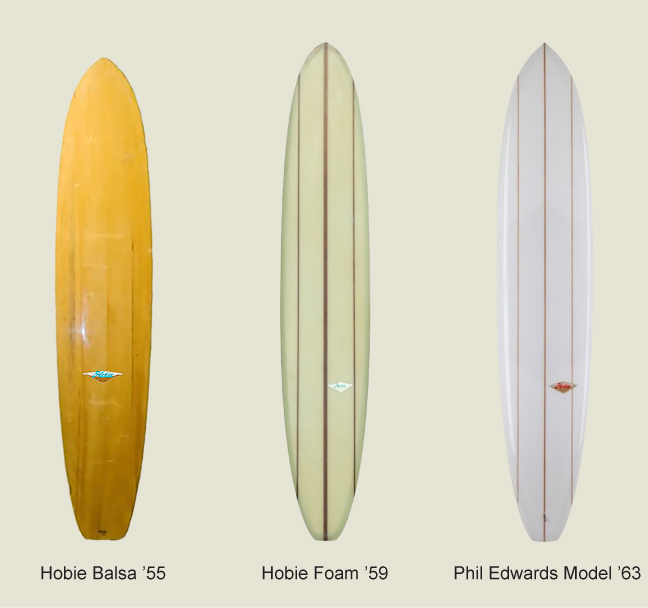 |
| The 1950s was an era of massive transition featuring revolutionary lightweight materials and rapidly evolving designs. Initially these boards were balsa wood core with fiberglass and resin skins. In 1958 Hobie Alter in collaboration with Gordon Clark developed polyurethane foam cores. At the same time Dave Sweet was also developing polyurethane foam cores. PU foam ultimately replaced balsa as it was efficient, readily available, easy to shape, and ultra light compared to balsa. The early 60s saw the first signature models designed and shaped by the premier surfer shapers of the 50s and 60s. These boards were the forerunners of the Longboard Revolution. |
| 1960 to 1967 | |
|
THE LONGBOARD REVOLUTION
The Longboard Revolution was inspired by the performance surfing and the creativity of the premier surfer shapers of the 50s and 60s coupled with the continuing development of the sandwich construction technology with polyurthane foam cores and fiberglass and resin skins. Lightweight polyurethane foam blanks were notably easier to shape than balsa wood. Shapers experimented with all the fundamental variables identified by Simmons and Quigg - rocker, profiles and foils, bottom contours, outlines, and rails. These evolving designs offered exceptional longboard performance. REVOLUTIONARY LONGBOARDS |
|
 |
|
|
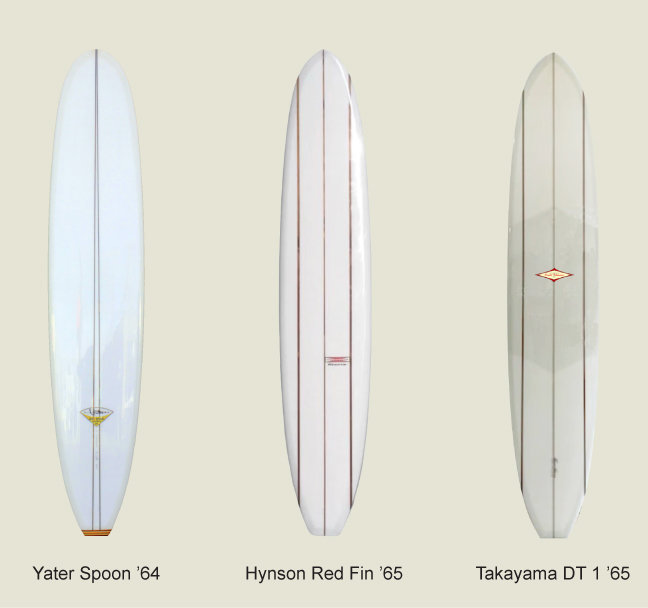
The Longboard Revolution included historically innovative and
creative surfboard designs - the Dale Velzy Pig, the Phil Edwards
Signature Model, the Yater Spoon, the Hynson Red Fin, the G&S Skip
Frye Model, Bing and Jacobs Takayama Models, the Brewer Pipeliner,
and Nat Young's board Sam that he famously rode to a World Title in
1966.
HIGH PERFORMANCE LONGBOARDS |
|
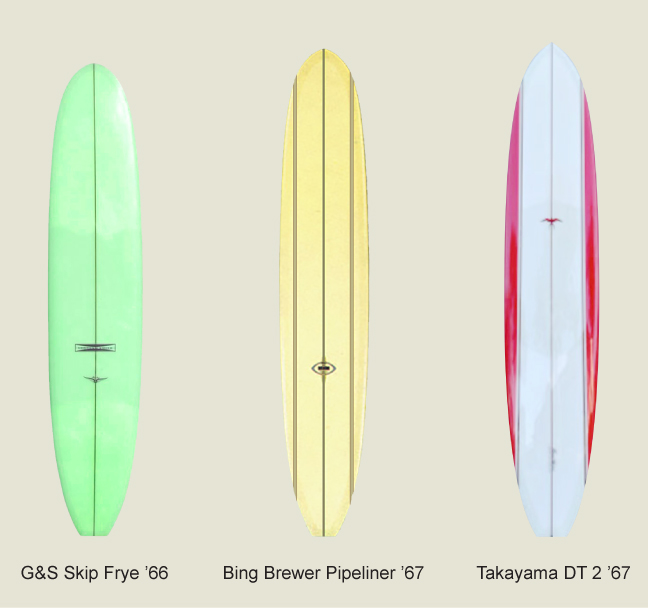 |
| The lightweight foam cores combined with the fiberglass and resin skins introduced the surfboard construction model that continues to be the primary model to this day. |
| 1967 to 1971 | |
|
THE SHORTBOARD REVOLUTION
This epic and monumental era saw a significant reduction in surfboard length and weight and a quantum leap in surfboard design and performance surfing. This era was known as the Shortboard Revolution. Surfer shapers like George Greenough, Bob McTavish, Dick Brewer, and Mike Diffenderfer shortened boards and integrated nuanced design elements to make them faster and more maneuverable, laying the foundation for modern performance surfing. Simmons' and Quigg's influence remained essential and constant. Their ideas and creativity were fundamental to recognizing rocker and bottom contours as essential elements of surfboard design. Rockers, profiles and foils, outlines, bottoms contours, and rails evolved from the imagination, ideas, and the creativity of these surfer shapers. Increasingly evolved shapes and lighter boards had a dynamic effect on surfing and surf culture. TRANSFORMATIVE BOARDS |
|
 |
|
|
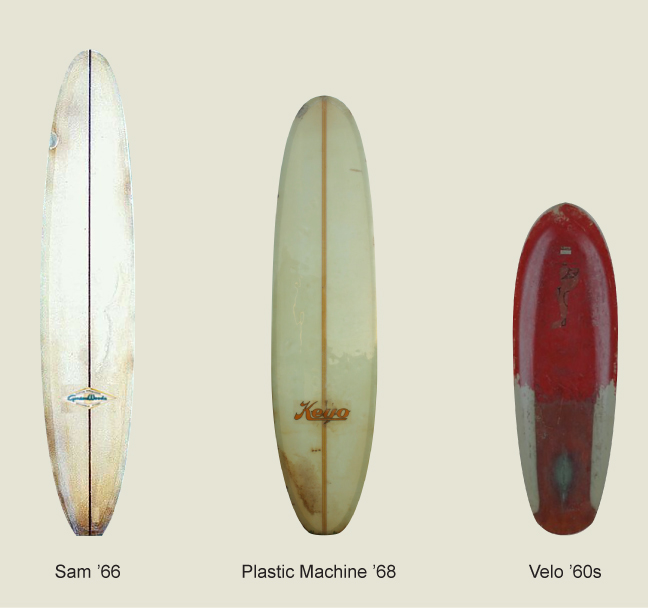
Sam was a single fin longboard, but Nat Young surfed it like a
shortboard. His aggressive carving turns were forerunners of
shortboard surfing and motivated an imaginative and creative
avalanche of revolutionary surfboard designs. McTavish's Plastic
Machine was a pivotal design in the shortboard revolution. His design
radically enhanced the ability to perform aggressive, powerful
vertical turns. George Greenough's surfing on Velo was the prototype
for modern on rail surfing. Notably, his surfing inspired Nat Young
and Bob McTavish as well as numerous surfers and shapers worldwide to
evolve their surfing and their surfboards during the Shortboard
Revolution. In 1967 and 1968 the evolution of surfboard design was
quantum and spectacular.
CREATIVE & REVOLUTIONARY BOTTOM CONTOURS |
|
 |
|
|
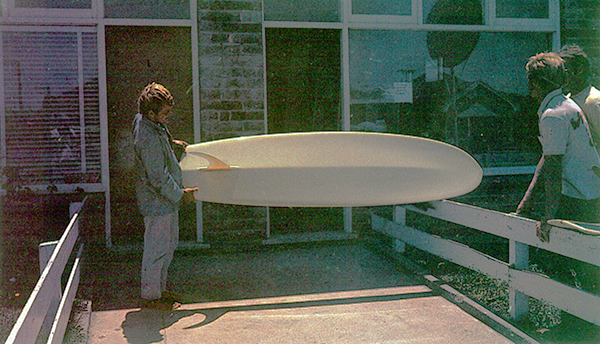
McTavish's early shortboards were very creative. Inspired by
George Greenough's surfing and his own imaginative surfing and
his shortened designs his boards were on the leading edge of the
shortboard revolution. The spiral vee double concave bottom in this
image is an extremely radical example of his imagination and
creativity.
EVOLUTIONARY SHORTBOARDS |
|
 |
|
|
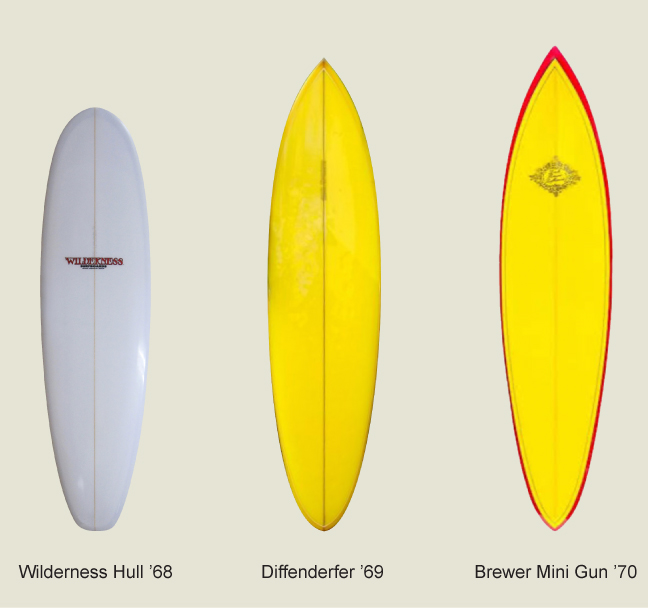
Three revolutionary shortboards from 1968, 1969 and 1970 - the
Wilderness Hull, the Diffenderfer Round Pin, and the Brewer Mini Gun.
By the 1970s the Diffenderfer Round Pin and the Brewer Mini Gun
cemented themselves as the prototypes for the modern high performance
shortboard. Shortboard designs continued to be based on the
fundamental variables identified by Simmons and Quigg. Rocker,
profiles and foils, outlines, bottom contours, and rails continued
their nuanced evolution.
THE FISH |
|
 |
|
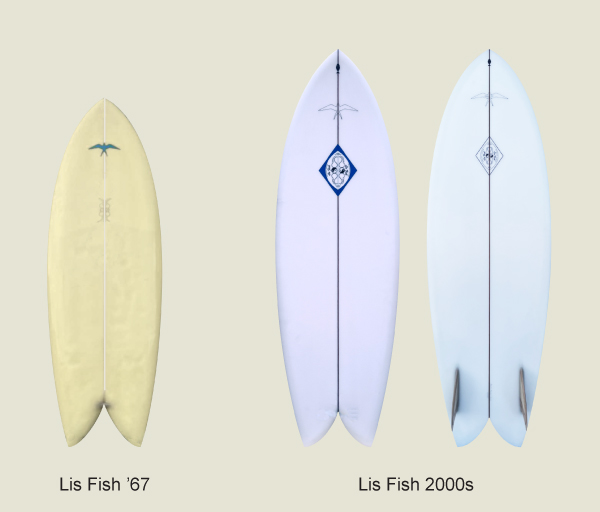
| In 1967 San Diego kneeboarder Steve Lis designed and created the Fish, another pivotal design in the Shortboard Revolution. He shaped and crafted this twin fin board from a broken longboard, designing it for more speed and maneuverability in the critical and often hollow waves he surfed. Lis' Fish design featured a short wide twin pin outline, low rocker, and two keel fins. Originally designed as a kneeboard, the Fish became popular with standup surfers for its speed and maneuverability across the full spectrum and variety of waves and conditions. The Fish has had a major effect on surfboard design and remains a very popular design. |
| 1970s & 1980s | |
|
The 70s & 80s were decades where the fundamentals of Simmons and
Quigg and the Diff Round Pin and the Brewer Mini Gun designs
continued to be the the basis for the primary prototypes for
progressive high performance surfboards. Dimensions and curves varied
for different waves and conditions. Rockers evolved to fit into ever
more critical sections of waves. Outlines became more versatile
particularly featuring fuller tails. Bottom contours in the 70s were
generally convex with subtle vees and tri planes. In the 80s multiple
concave bottom contours became more and more common. Dick Brewer and
Mike Hynson introduced and institutionalized down rails from nose to
tail. The Shortboard Revolution of the late 60s transitions to
decades of surfboard design evolution.
70s & 80s SHORTBOARDS |
|
 |
|
|
LIGHTNING BOLTS
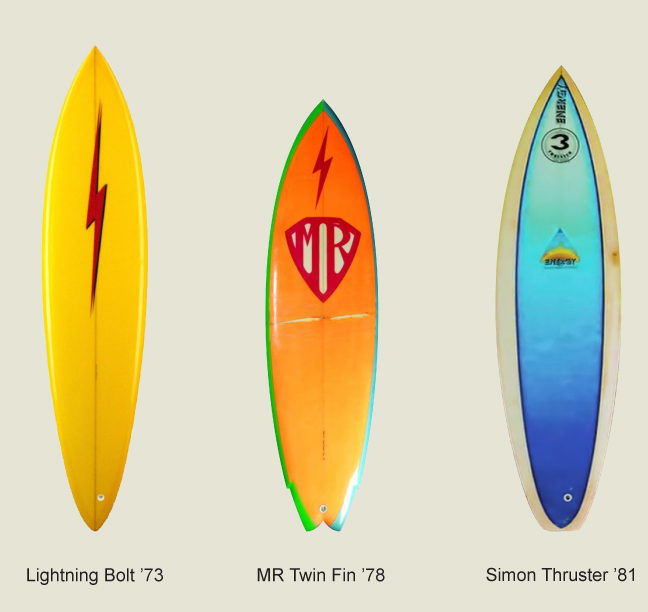
In 1971 Gerry Lopez and Jack Shipley formed Lightning Bolt surfboards. Lopez's designs and shapes were fast and maneuverable and could be customized for heavy water waves like Pipeline and to a full variety of waves from critical to user friendly worldwide. Even more interesting than the designs and shapes evolving in the 70s and 80s was the creation of the Mark Richards Twin Fin and the Simon Anderson Thruster. These two fin design concepts created a massive shift in the maneuverability of surfboards. MR TWIN FIN In the 1970s Mark Richard found his relatively narrow tailed single fins difficult to turn and maneuver in marginal and smaller surf. The concept of a surfboard with two fins existed decades before he developed his twin fin. In the 40s Bob Simmons designed a surfboard with two fins to stabilize and control his boards. In the late 60s Surfboards La Jolla's Nick and Bear Mirandon created their Twin Pin design. At the same time in the late 60s Steve Lis created the Fish featuring two keel fins. Inspired by two fin history MR shaped his first modern twin fin in 1977. The design offered a new level of performance in marginal and smaller waves. The success of MR’s twin fins was pivotal in the transition from single fins to twin fins and ultimately to thrusters in the early 1980s. The unique performance of the twin fin remains popular with a wide variety of surfers and is functional for every surfboard design class. SIMON ANDERSON THRUSTER In late 1980 Simon Anderson created the Thruster fin configuration. The Thruster featured three fins of the same size and offered a unique combination of speed, stability, maneuverability, control, and predictability. The performance of this fin configuration had a massive affect on surfing and surfboards. Instantly the Thruster became the primary fin configuration for shortboards and remains so to this day. Anderson's three fin design offered the speed and maneuverability of a twin fin with the control, stability, and predictability of a center fin added to the configuration. ICONIC 80s BOARDS |
|
 |
|
|
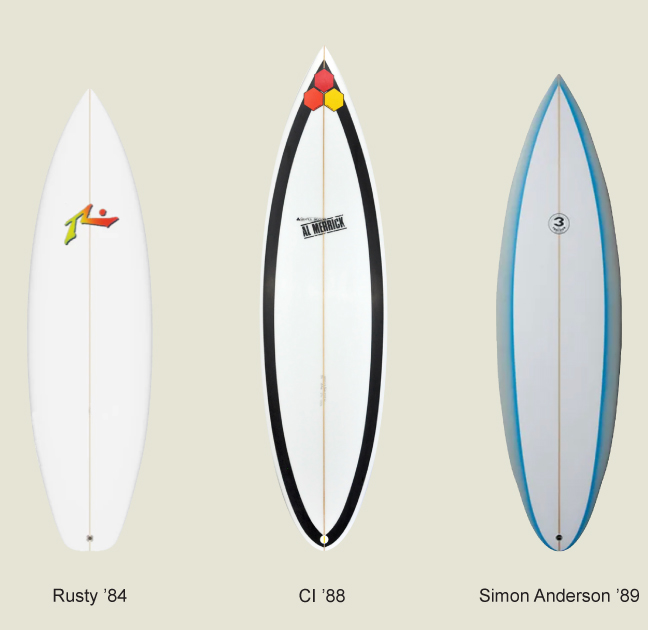
Three iconic brands from the 80s - a Rusty, a Channel Islands,
and a Simon Anderson. Universally shapers refined all the fundamental
design elements tuning rocker and outlines to fit the curves of
waves, foiling rails to engage waves with predictability and control,
and exploring and creating bottom contours to maximize lift, reduce
drag, and increase maneuverability.
MICHEL BARLAND CREATES THE FIRST CNC SHAPING MACHINE Nearly two decades before CNC shaping became mainstream in surfboard shaping and manufacturing, Michel Barland launched this technology designing and building the first surfboard specific CNC shaping machine. Barland was a mechanical engineer, industrial designer, and manufacturer with a metal works in Southwest France. He was also one of the "Tontons du Surfeurs," the first generation of French surfers, and was the first French shaper, and with Jacky Rott the first surfboard manufacturer and brand in France. He designed and built his original shaping machine in his metal works in Bayonne, France and collaborated with a computer scientist to develop the design and machine software. The precision, consistency, and efficiency of CNC shaping and the control of variables and design features in design software ultimately provide shapers with a very powerful design and manufacturing tool. |
|
1990s
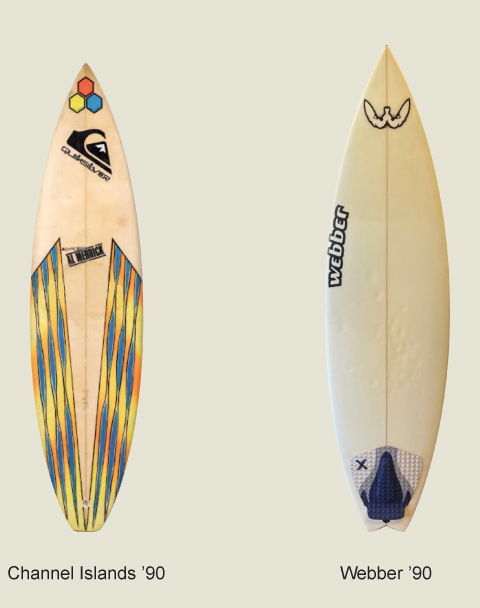
THE GLASS SLIPPER - EVOLUTION & DEVOLUTION Inspired by the surfing of the Momentum Generation, shapers worldwide designed increasingly shorter, narrower, and thinner boards with extreme rocker. This design became known as the Glass Slipper. The Glass Slipper was an extremely low volume surfboard. It was short, narrow, and thin with extreme rocker nose to tail and a multiple concave bottom. Common dimensions were 6' 0" x 17 3/4" x 2". These extremely low volume boards surfed incredibly well in the pocket of critical waves, but they failed to maintain their speed and energy through less critical sections. Shortboard volume remained low through most of the 90s before it became obvious that the Glass Slipper required more volume to be an effective and universally functional design. GLASS SLIPPERS |
|
 |
|
|
Glass Slippers shaped in the early 90s by Al Merrick at Channel
Islands and Greg Webber in Australia. The Glass Slippers introduced
radical dimensions and evolutionary design features. They were
extremely narrow and thin, featured significant rocker in the nose
and tail, and deep concaves from nose to tail.
The late 80s and early 90s saw the reemergence of longboards and the development of mid length designs. These higher volume designs were relevant to and very popular with the increasing number of novice and recreational surfers who struggled to enjoy surfing lower volume shortboards. While the Glass Slippers were gaining popularity among most surfers, the popularity of surfing longboards and mid length boards began to grow exponentially for recreational surfers who didn't want to struggle surfing low volume high performance shortboards. Clark Foam, which was still supplying the foam cores for the vast majority of all surfboards on the market, said that the end of the 90s saw a 50 / 50 split of under 8 foot and over 8 foot blanks sold. |
|
2000s
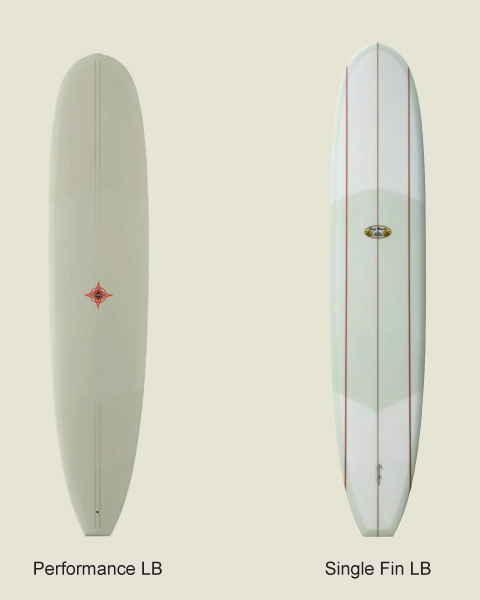
Surfers and shapers added volume and modified rocker to the Glass Slipper design and developed shorter, wider, higher volume boards with nuanced rockers, profiles, and foils that were user friendly and maintain and further evolve surfboard performance. The 90s and early 2000s saw the introduction of CNC technology to surfboard design and manufacturing. Designing and milling with CNC technology allowed a new level of precision and consistency for surfboards. This technology made the design and manufacturing process faster, consistently more precise, and offered the ability to control design variables with greater precision. Surfboard design and machine software continue to evolve, milling highly customized boards that can be designed and shaped to any surfer's unique preferences. CLARK FOAM CLOSES In December 2005 Clark Foam, the world's primary and largest supplier of polyurethane foam blanks, closed. After the initial shock new sources of polyurethane foam emerged. Shapers and manufacturers embraced alternative materials to the PU / PE construction schedule. EPS / Epoxy boards become mainstream with EPS foam and Epoxy resins developing surfboard specific qualities. EPS / EPOXY BOARDS When Clark Foam closed abruptly in 2005, the world's largest producer and supplier of polyurethane foam surfboard blanks ceased manufacturing blanks without warning or explanation. Blank inventories sold through overnight, inventories and distribution of other essential materials and supplies were affected, surfboard inventories quickly sold through, and board prices rose substantially. Innovative designers took the opportunity to explore alternative efficient means of surfboard design and manufacturing. EPS foam cores became an immediate alternative to polyurethane foam cores. The modern era of EPS / Epoxy surfboards was born. EPS / Epoxy based surfboards continue to gain popularity. They are generally lighter and very lively and have a different flex pattern and feel compared to Polyurethane / Polyester boards. These properties make EPS / Epoxy boards excel in smaller less powerful waves and conditions. PU / PE remains the most common construction for most boards. Heavy water and XXL boards are nearly all PU / PE construction. In 2006 Firewire begins manufacturing quality EPS / Epoxy surfboards on a production level. Their technology and variety of designs offered a quality alternative to custom shaped boards. Alternative designs become popular with the growth of surfing. Designs are created and adapted for the full spectrum of surfers. Shortboards, mid lengths, longboards, fish, and other designs are widely available and continue to evolve. LONGBOARDS & MID LENGTHS REEMERGE In the late 80s and early 90s longboards reemerged in surfing. These boards featured two distinct design threads. One a contemporary performance longboard designed to carve like a shortboard and trim and nose ride like a traditional longboard. The other an evolved single fin longboard designed to perform like the classic longboards from the peak of the longboard revolution. LONGBOARDS |
|
 |
|
|
When longboarding first reemerged longboards and longboard
surfing were an extension of shortboard surfing. In the 90s a new
generation of surfers and shapers embrace pre shortboard single fin
longboards and surfing and develop evolved classic single fin
longboards.
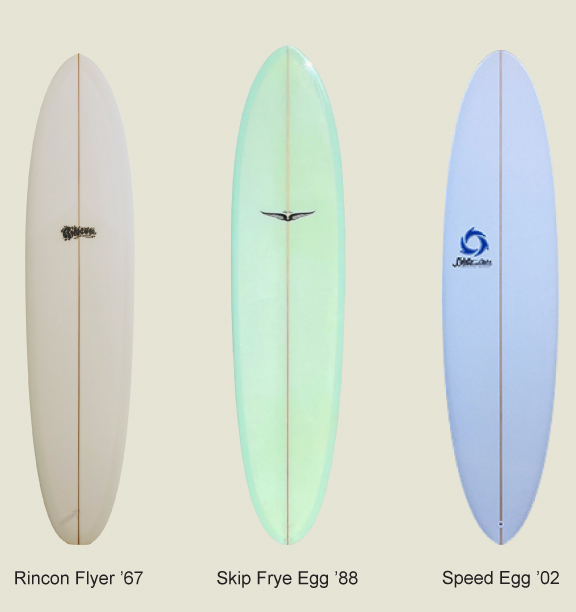
The first mid length surfboards appeared in the late 60s during the shortboard revolution. Bob McTavish's Rincon Tracker and Skip Frye's Eggs were the first mid length surfboards, even though they were considered shortboards at that time. These boards were consequential designs in the shortboard revolution, revolutionizing surfing performance. MID LENGTHS & EGGS |
|
 |
|
|
In the 2000s mid length surfboards initially gained popularity
among recreational surfers as a diverse and user friendly surfboard.
Eventually mid length boards became increasingly popular and common
to surfers of all skill levels due to their evolution, their ease to
surf, and their performance in a wide and diverse range of
conditions.
2010s COMPUTERIZED SHAPING ACCELERATES DESIGN INNOVATION Computer Aided Design and Computer Aided Manufacturing in the mid 90s opened the doors of innovation and creativity even further. These technologies greatly streamlined the surfboard design and shaping process, allowing for easier mass production and innovation. SHORT, WIDE & PRACTICAL - COMPACT USER FRIENDLY VOLUME In early 2000s the ability of CAD software to accurately measure a full range of surfboard dimensions allowed the concept of volume to became another variable that could be measured and quantified. The measure of volume helped surfers and shapers tune boards to the correct and functional volume across all surfboard classes. Greater knowledge of volume helped develop higher volume shorter, wider, and thicker shortboards for a broad spectrum of surfers. Surface area, profiles, and foils are varied to add and remove volume. CONTEMPORARY SHORTBOARDS |
|
 |
|
|
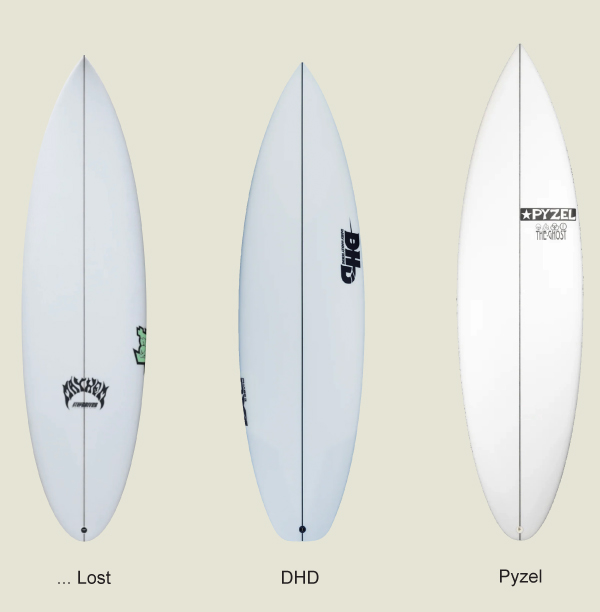
Three contemporary shortboards - higher volume boards remain
short, fast, and maneuverable, and offer the opportunity for expanded
high performance surfing on more versatile and functional boards than
the Glass Slipper. The broad spectrum of designs with increased
surface area and volume are well suited for twin fins, quads, and
other fin configurations. Imagination, ideas, and creativity generate
diverse and alternative designs. Asymmetrical boards are explored,
theorizing, designing, and testing surfboards that were uniquely
suited to specific surfers and waves.
Shortboards are shorter, wider, and moderatley thicker with volume matching surfers' size and skill. Mid lengths evolve substantially as more surfers embrace the design. Performance and single fin longboards also continue to evolve. More alternative designs emerge. Surfers and shapers explore asymmetrical boards and alternative materials. Modern surfboard designs continue to develop through incremental and quantum innovations and refinements. 2020s Surfers, designers & shapers evolve designs incrementally & in quantum leaps Increasingly diverse designs & classes of boards emerge Construction concepts, innovations, schedules & materials evolve Computerized shaping continues to evolve |
| |
|
| |
< top of page > |