
| |
|
|
|
| Home | | | Surfboards | | | Design | | | Surfing & Media | | | Surfcast | | | About NC | | | Custom Orders | | | Contact |
| |
|
| |
ASYMMETRICAL SURFBOARDS
OVERVIEW An asymmetrical board is a board with two distinct and different sides, a surfer’s toe side and heel side. The two sides are designed for how human anatomy and biomechanics affects front side and backhand surfing and turns and / or designed for direction or wave specific surfing. Each side has its own outline and tail template. Although they share rocker along the stringer they have their own unique rail rocker. Each side has its own rail profile and rail volume, bottom contours, and fins and fin placement. FRONTSIDE & BACKHAND SURFING & TURNS Frontside and toe side surfing and turns and backhand surfing and heel side turns (or semantically frontside and backhand surfing) are fundamentally similar in that surfers engage their boards in waves and generate projection, acceleration, speed and perform maneuvers by nuanced weighting and unweighting of a board’s design features - the rails, bottom, bottom contours, outline and fins. But toe side and heel side turns and maneuvers differ due to human anatomy and biomechanical differences. And consider that when surfing a right hand or left hand wave a surfer will do both frontside or toe side turns and backhand or heel side turns. Ultimately the prime variables in asymmetrical surfboards are human asymmetry and the biomechanics of toe and heel side surfing and the nature of specific waves being surfed. |
| |
|
| |
ASYMMETRICAL SURFBOARD HISTORY
Asymmetrical surfboards emerged in the mid 1960s. Carl Ekstrom, a San Diego surfer, designer, and shaper was one of the first to experiment with asymmetrical design features. He observed that surfboards fundamentally rode different frontside and backhand. Often a board that performed well toe side surfing didn’t perform as well on the heel side and vice versa. |
| |
 |
| |
|
| |
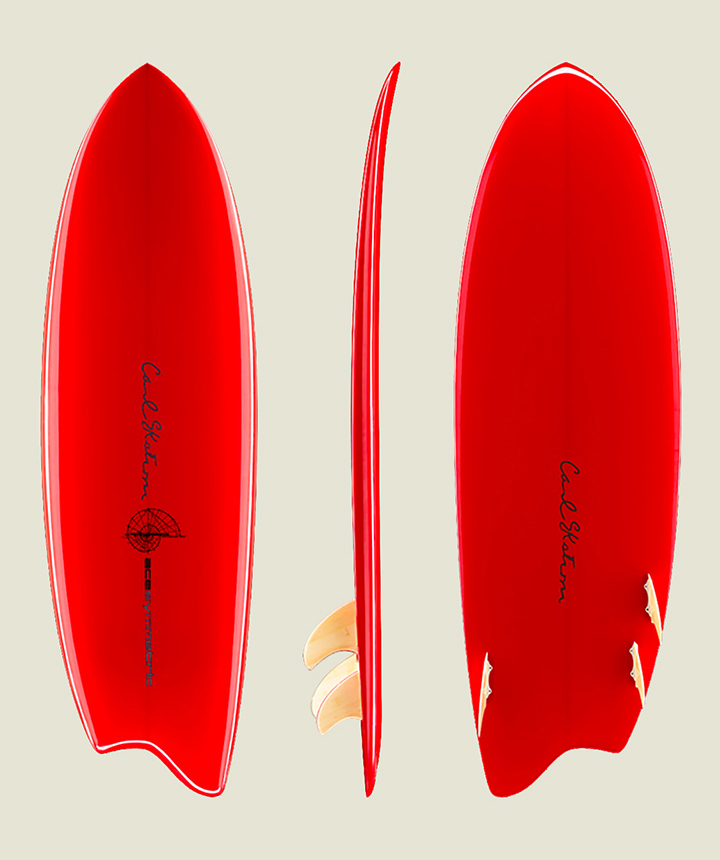
Carl Ekstrom Asymmetrical |
| |
|
| |
"I wanted more curve on the backside and a twist in the tail so
that the tail would be higher on the heel side, so I designed the
first asymmetrical surfboard," Ekstrom once said. His goal was to
create a board that performed equally well frontside and backhand at
his local surf spot, Windansea.
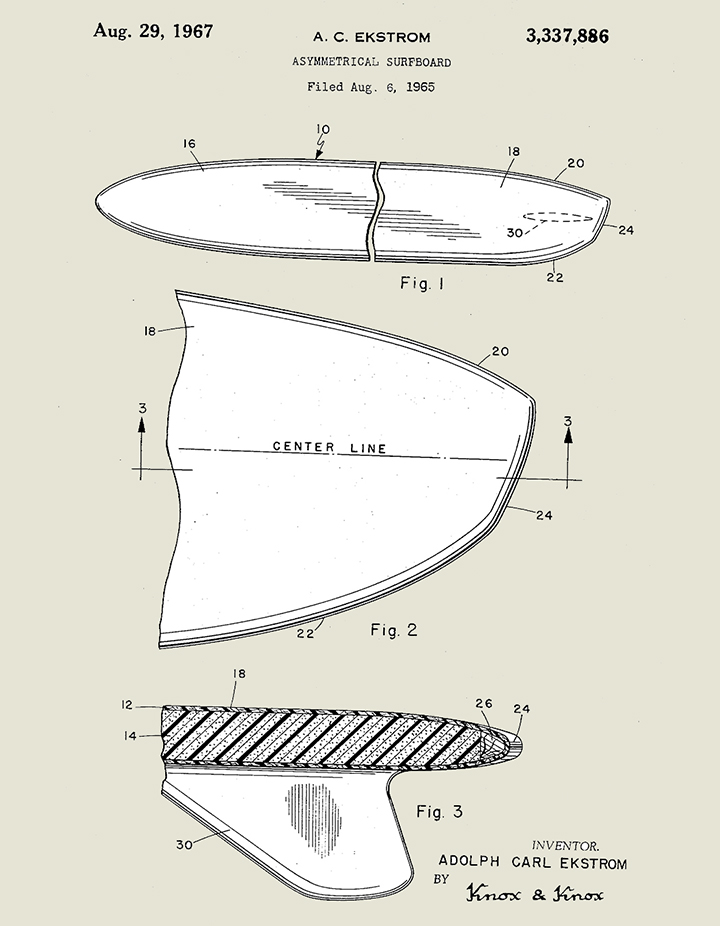
In 1965, he combined his favorite frontside and backhand board design features most notably the rails, outline, and tail into one highly nuanced board. He filed for a patent for his design in 1965. It was granted in 1967. Of note, due to the nature of surfboard design, a patent for a specific surfboard design is extremely unique. |
| |
|
| |
 |
| |
|
| |
Carl Ekstrom Asymmetrical Board Patent |
| |
|
| |
THE GOAL of ASYMMETRICAL BOARDS
The goal of an asymmetrical board is to design features that optimize performance for both toe and heel side surfing, turns, and maneuvers and / or performance in specific waves in one board. Asymmetrical boards feature longer toe side and shorter heel side outlines, with wide point forward on the toe side and back on the heel side, a moderately fuller nose on the toe side and moderately narrower nose on the heel side, and a different tail template on the toe and heel side. Entry and mid board rocker are similar side to side with lower tail rocker on the toe side and accelerated tail rocker on the heel side. Rail profiles and rail volume are slightly lower on the toe side rail and slightly fuller on the heel side. All these design features are synchronized with a surfer’s anatomy and the waves they surf. |
| |
|
| |
ASYMMETRICAL BOARD ANATOMY & SUMMARY
There is no standard asymmetrical board. Asymmetrical boards can be designed and shaped to suit any surfer and any wave. The primary distinction of an asymmetrical board is that the toe side and heel side of the boards are fundamentally different. Generally an asymmetrical surfboard features one rail longer than the other. This is the toe side rail. The toe side design elements emphasize projection, acceleration, speed, and maneuverability. The heel side rail and tail are shorter and feature more curve in the outline and accelerated tail rocker to offer quick and additional maneuverability. Fins and fin placement are an important part of an asymmetrical board’s design. They enhance the performance features offered by the asymmetrical outline, rocker and profile, bottom contours, and rails. |
| |
< top of page > |